For decades, only engineering ran its work as code. Now every function's output is becoming structured and machine-readable, and AI ships it at machine speed. Governance is the next discipline to move into the pipeline, so assurance keeps pace with how fast the work now moves.
The shift
When the work becomes code, governance has to follow.
Everything as Code closed the gap between development and operations, then between development and security. Governance is the next wall to fall: policy, controls, and evidence expressed as code and run inside the pipeline, governed the same way the software is.
01
Policy as Code
Policies expressed and versioned as code, reviewed like software rather than filed in a binder.
02
Controls as Code
Controls that operate continuously, projected from live data instead of checked twice a year.
03
Evidence as Code
Audit evidence generated as work ships, append-only and signed, so there is nothing to assemble before a deadline.
04
Audit as Code
Assessments and framework mappings drawn from current posture, so nothing gets reconstructed by hand.
05
AI-SDLC Pipeline
The development harness. Every change, human or AI, passes the same review, scan, test, and deploy gates.
06
AI-Enabled Governance (ICRG)
The governance harness. One control posture projected across every framework you report against at once.
Why now
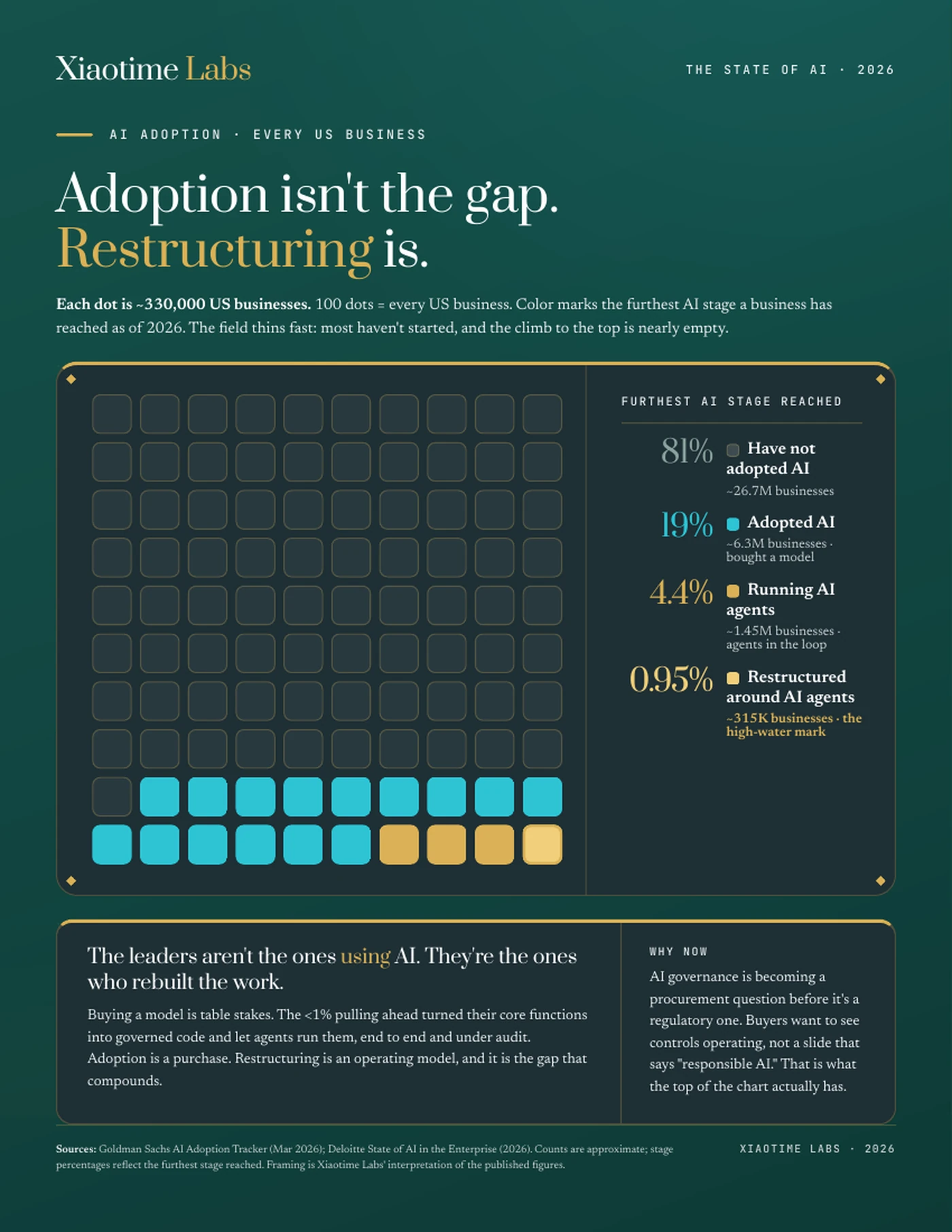
Under one percent of US businesses have restructured around AI agents.
Almost everyone else counts as an adopter on the strength of a purchase. Buying a model is not an operating change, and the distance between the two is where the assurance gap opens up.
81%
have not adopted AI at all
19%
adopted AI, meaning they bought a model
4.4%
are running agents in the loop
0.95%
restructured the work around those agents
Goldman Sachs AI Adoption Tracker (March 2026); Deloitte, State of AI in the Enterprise (2026). Counts reflect the furthest stage reached. Read the full brief →
Ready to operate as code?
Governance as Code is how leaders keep AI moving fast without losing the controls. Start where the value is clearest, and expand from there.